
Custom Jewelry Wholesale Costs After the Sample
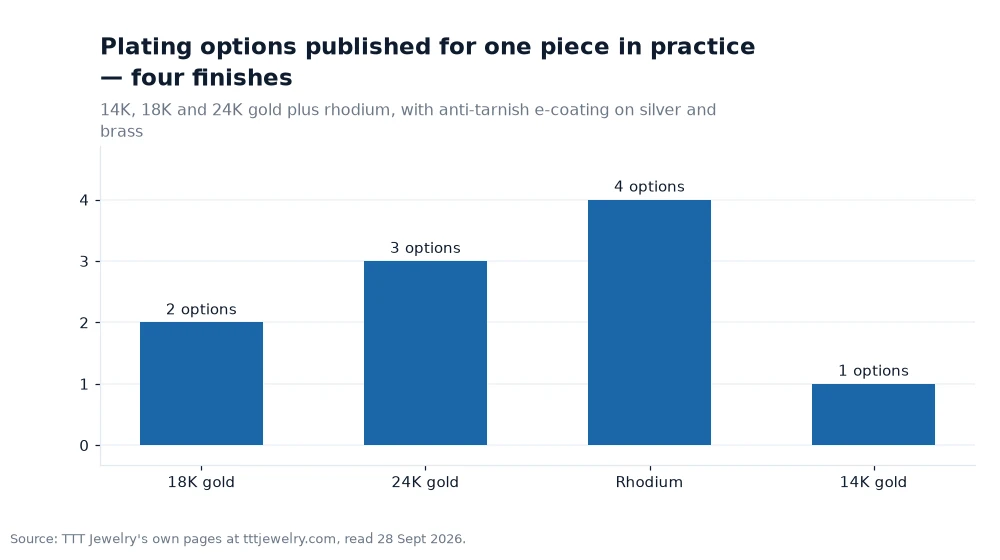
The sample settles the design, not the price. What moves after approval is the specification around the piece: the plating stack, the packaging, the quantity the fixed costs are spread across, and the finishing the sample proved necessary. Four plating finishes are published — 14K, 18K and 24K gold and rhodium — and each is a separate line in a quotation rather than a colour option on a page.

Key takeaways
- Four plating finishes are published: 14K, 18K and 24K gold and rhodium, applied as multi-layer electroplating.
- Silver and brass add a protective anti-tarnish e-coating; stainless steel uses PVD vacuum plating.
- Fixed costs are paid once per design, so the per-piece share at 50 pcs is double that at 100 pcs.
- Minimums run 100+ pieces in stainless steel, 50 units in 925 sterling silver and 100 in the eco-brass line, counted per design, applied design by design.
What actually changes once the sample is approved
The sample answers questions about geometry: whether the casting fills cleanly, whether the stone sits properly, whether the finish reads the way the drawing promised. What it does not answer is how those answers scale across a batch.
Four lines move after approval. The plating stack is fixed first, because the finish has to repeat exactly. The packaging is confirmed next. The quantity follows, since it sets how far the fixed work spreads. Last comes any finishing step the sample showed was necessary, such as an e-coating on silver or brass.
None of those is a hidden charge. Each is a published option, which is the reason a quotation can be checked line by line against a specification rather than accepted as a total.
Sample confirmation is the gate that closes the costing conversation, and it is the fourth of five service steps published for the line: concept and design, master sampling, quality inspection, sample confirmation, mass production. The three specialised services alongside it — design to mass production, logo and text engraving, and bespoke packaging design — are the scope items that can arrive with a price attached, which is why they belong on the same sheet as the plating stack and the packaging list.
Plating is a specification, not a colour
Multi-layer precious metal electroplating is published in 14K, 18K and 24K gold and rhodium. Those are four different processes, not four swatches: the metal used and the number of layers both change what the workshop consumes and how long the piece spends in the plating stage.
On silver and brass, a protective anti-tarnish e-coating is added over the plated layer. That is a separate operation, and it is what keeps a gold-toned brass ring from dulling on a display stand. Stainless steel takes a different route entirely, through PVD vacuum plating.
The costing consequence is simple to state and easy to miss: choosing a finish is choosing a process. Two pieces with identical geometry and different finishes are not the same order.
Packaging lines that arrive late in the conversation
Custom packaging is one of the six published specification points and covers gift boxes stamped in foil, display backing cards, metallic logo tags, velvet/microfiber pouches and barcode labelling. Each item is sourced for the run and each carries its own unit cost and its own minimum.
Confirming packaging after the jewelry has been quoted produces a second quotation rather than a single number, which makes two suppliers harder to compare. The fix is to specify it in the same message as the metal and the finish.
Barcode labelling is the line that turns into labour if it is missing, because a fulfilment centre receiving unlabelled stock has to pack it by hand.
How quantity changes the per-piece arithmetic
Some costs are paid once per design: CAD modelling under 48 hours, the mould, the plating setup. Others scale with the pieces. The fixed group is what makes the minimum order quantity matter, because it is divided across the run.
Written as a formula, the fixed share per piece is fixed cost ÷ quantity. At 50 pieces that share is fixed ÷ 50; at 100 pieces it is fixed ÷ 100, which is half as much per piece.
MOQ is 100 pieces in artisan eco-brass, 50 pieces in 925 silver and 100+ pcs in stainless, counted per design, meaning the totals scale with the number of designs. So a silver design at its minimum carries twice the per-piece fixed share of a brass design at its minimum — a comparison worth making before deciding which metal carries the launch, and the one piece of arithmetic behind most custom jewelry wholesale costing decisions.
The lines that never appear on a quotation
Four costs live outside the quote. The first is approval time: sampling runs 25–30 days, and each extra feedback round pushes the production start rather than shortening the window. The second is freight and customs, which sit outside the production window entirely.
The third is the courier legs of the sample itself, which travels out to the buyer and back if a change is agreed. The fourth is a specification change after tooling, which reopens setting, polishing and plating rather than editing a drawing.
A supplier holding one named project manager and a 24-hour response standard is the published answer to the first and fourth of those. The other two are the buyer's to plan.
Making two quotations comparable
Comparison only works if both numbers describe the same piece. The specification sheet is what makes that possible: metal, finish, chains, stones, hallmark and packaging, all six written down before any discussion of price.
Bring that sheet when you get a quote for the same design elsewhere, and the second figure will describe the same object as the first. Bring it to a supplier that itemises against those six lines and the two quotations can be read side by side without assumptions.
A quote that cannot be broken down against the specification is not comparable, however competitive the total looks. The detail is where the difference between two apparently similar numbers lives.
| Cost line | Published detail | What drives it |
|---|---|---|
| Plating stack | 14K / 18K / 24K gold, rhodium | Metal chosen and number of layers |
| Anti-tarnish e-coating | added on silver and brass | An extra finishing operation after plating |
| Packaging | 5 published items | Unit cost and its own minimum |
| Quantity | 50 / 100 / 100+ pcs by metal | How far the fixed costs spread |
Worked example: the fixed share at 50 pieces against 100
Treat the one-off work as a single fixed amount: CAD under 48 hours, the mould, and the plating setup are paid once per design. Call that total F. The per-piece share of F is F ÷ quantity.
At the silver minimum of 50 pcs the share is F ÷ 50 = 0.02F per piece. At the brass minimum of 100 pcs it is F ÷ 100 = 0.01F. The silver minimum therefore carries twice the per-piece fixed share, and the two runs differ by exactly that factor.
The arithmetic uses only published minimums and no prices, which are not published anywhere. Its use is directional: doubling a silver order from 50 to 100 pieces halves the fixed share per piece without changing the design, the mould or the specification.
Frequently asked questions
Which plating finishes are published?
an anti-tarnish e-coat applied to silver and brass, PVD plating on stainless work, rhodium and 14K/18K/24K gold.
What is included in the minimum order quantity?
Minimums run 50 units in sterling silver, 100 in artisan brass and 100 plus in the stainless line, counted per design, so per-design floors stack with each new design.
Does the sample price carry over to the production run?
The sample is a separate one-off. Production is quoted from the approved specification and the quantity, with the fixed work spread across the batch.
Reading a quotation against the specification
A wholesale quotation is really six decisions with a number attached, so it pays to hold it against the full option list — the published answers cover the minimums and windows that most quotes assume, and checking them takes minutes.
For a plated line where the finish is the main cost variable, the sterling silver finishing details explain why silver and brass carry an extra protective step that stainless steel does not.
What this article works from — the six customisation fields plus the five packaging components as well as the three service strands — is written up at tttjewelry.com, as of 28 Sept 2026. Nothing else here is inferred. The sums behind the example belong to me rather than the client[1].